|


|
Main > FAQs > Basic Gaming FAQ
Basic Gaming Advocacy FAQ This FAQ page covers two main subjects: 1. What roleplaying games are and how they are played. 2. The myths and misconceptions that have accumulated about them over the years.
One of the best ways I have heard to describe role-playing to a non-roleplayer is this one: Think of some of your favorite boardgames that you like to play, now or when you were younger; popular games like Monopoly, Battleship, Clue, Stratego, or Risk. Try to imagine playing one of those games while stepping into the role of a shrewd businessperson, a Navy captain, a master detective, or Army General. Now, instead of just rolling dice, drawing cards, and moving pieces around the board, you're acting out that role, interacting with the other players who are doing the same thing, and creating a story as well as playing a game.
In all, it's very similar to the childhood game of "let's pretend" or "cops and robbers," but with rules and a referee. In such games, all actions taken by the characters and referee are described, not performed, and the players do not usually dress as their characters. This distinction is made to differentiate RPGs from LARPs, which are described below. In most of these games, dice are used to generate random numbers to resolve certain events (such as whether a character can climb a slippery wall, or if an attempt to fast talk a guard will work). These dice come in an array of shapes and sizes; a common set of dice includes 4-, 6-, 8-, 10-, 12-, and 20-sided dice. Some games use a complete set of these dice (Dungeons & Dragons and Call of Cthulhu are two examples), while others may only use one particular kind (GURPS uses only 6-siders, for example, while the World of Darkness games use only 10s). In others, dice are replaced with other randomizers such as cards, or in some cases, removed altogether in what is often called a "diceless" system. Miniature plastic or metal figures are used in some games, such as Dungeons & Dragons, to help the players visualize where their characters are in a scene. They aren’t used in many RPGs, however, so you frequently will not see them at a game session. There are also strategy wargames that use the same or similar figures – these games are also a lot of fun, but are not the same thing as a role-playing game.
Not really. RPGs are usually played in a comfortable area with a table where everyone can relax while they play and have somewhere to put their books, notes, and dice. There is a “sister” hobby to RPGs called Live Action Role Playing (or LARP for short - see below) where players dress as their characters and occasionally use props and/or foam weapons during the game. These are also a lot of fun.
Again, not really. Many people see the large amount of books – some of them very thick - that are available for a role-playing game and assume that every page is filled with rules. The truth is, most of the material found in any RPG book is background material for the setting – the characters, locations, and history of the game world in which it is played. The backgrounds of many RPGs are more detailed than those of the average sci-fi or fantasy movie or television series, and this can make the books very enjoyable to read. There are some RPGs that have rules that can be complex - Dungeons & Dragons would be a perfect example. But the trend in recent years has been towards games that have simple rules, and are quick and easy to learn and play.
With all due respect, the question of whether or not people still play Dungeons & Dragons is a bit silly. It's kind of like asking if people still read Robert Frost's poetry, watch I Love Lucy reruns, or play with yo-yos. Of course they do. All of those forms of entertainment are just as entertaining as they were when they were first created. Maybe the initial excitement about them isn't as high as it was then, but that doesn't take away from their pure entertainment value. Or, to create a better analogy - it's kind of like asking if people still play any other game that's any older than the latest releases. Try replacing "Dungeons & Dragons" or "roleplaying games" in that sentence to any other game - checkers, Mouse Trap, volleyball, Pac-Man, bridge - and you'll get a better idea of how silly a question it really is. To drive the point home a bit further, I made the timeline on the right. Feel free to refer people to it whenever they express astonishment that people still play Dungeons & Dragons. (Fun Fact: Go, a boardgame that originated in China, is so old that no one is certain just how old it really is - and there millions who still play the game. In fact, there are Go tournaments worldwide, and professional Go players!)
Some LARPs are non-physical, where participants are not permitted to touch each other or engage in any combat; others involve "boffer" weapons, special homemade swords, shields, daggers, axes, and even arrows that are covered in foam to protect the participants as they play against each other. The fact is, may of the people reading this have participated in a form of LARP before, or know someone who has, and they may not even realize it. The How To Host A Murder and How To Host A Mystery games, where players are handed cards with information about the character they portray and the information that they know, are really a basic form of live action roleplaying. (A new section of The Escapist devoted to LARP is currently in the works. Keep checking this space for more information.)
Frequently, some will confuse roleplaying games with collectible card games (CCGs), but the two are quite different. Collectible card games are played with decks of cards that have been customized by the players. The cards are usually purchased in "starter decks" (usually around 60 cards per deck) and "booster packs" (usually around 15 cards per pack), though there are some games that forego the starter deck and allow you to play with just a few booster packs. Each card has it's own characteristics, and players consider this when constructing a deck of them. Popular CCGs of today include Magic: The Gathering, Pokemon, and Yu-Gi-Oh. There are several themes and styles of CCGs, and the collectible format has even inspired other types of games, such as collectible dice games (Dragon Dice) and collectible miniatures games (Mage Knight, Heroclix, and many, many more). CCGs used to receive more coverage on this site early in their development, as they met with bans, lawsuits, and unwarranted negative press from people trying to eliminate them. Magic was frequently accused of inspiring players to learn occultism, for example, and the Pokemon craze once reached such a height that some considered suing the producers of the game for creating a method of illegal gambling (since valuable cards are inserted randomly into booster packs). Such claims and bans have dwindled in the last few years, but if they should ever begin to become more prevalent, you will read about them here, as well.
RPGs have become part of many urban legends, or modern-day tales of folklore that usually have very little basis in fact. One popular legend claims that swallowing Pop Rocks (a type of candy that pops in your mouth) and washing it down with a carbonated beverage will cause the stomach to explode, killing the imbiber - and that this was the fate of the young man who played Mikey in the Life cereal commercial. Most of us know that this is not true. Not only do we have a governmental body to protect us from such unfortunate accidents (the FDA), but "Mikey" (a.k.a. Michael Gilchrist) is alive, and doing quite well. Urban legends often sprout from actual events, but quickly degrade into stories that happened to "a friend of a friend," and begin to become more spectacular as they are passed on. In any case, they are hardly a reliable source of information. This case is certainly no exception.
The first incident involved a young man named James Dallas Egbert, a 16-year-old boy who was bright enough to be attending college at such a young age. Egbert had much more than his fair share of problems; he was under constant pressure from his parents to exceed, and was hiding his drug addictions and homosexuality from them. Egbert went into hiding for nearly a month, and was pursued by William Dear, a private investigator hired by his uncle to find him. Dear discovered that the boy occasionally played Dungeons & Dragons, and began searching for him based on the hunch that Egbert was playing the game in the steam tunnels beneath the dormitories. This sparked media stories associating the game with Egbert's disappearance; stories that were never retracted when the truth came out. When Egbert took his own life a year after being found, Dear let the story stand as it was, untrue and misleading, to "protect" the Egbert family from the truth about Dallas' secret life.
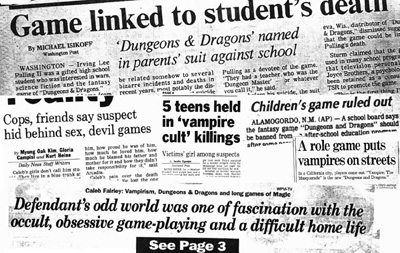
This event not only began the myth that role-playing can inspire suicide, but it also started the urban legend that gamers like to play in places such as steam or sewage tunnels. The second incident involved a young man named Irving "Bink" Pulling, who killed himself in 1982 with his mother's handgun. His mother Patricia believed that he had become involved in the occult, and that his suicide was due to a curse that had been placed on his character in a D&D game he played at his school. Her theory was possibly fed to her by a police investigator who questioned her after her son's death; before that time, Pulling had never heard of D&D, and didn't believe that devil worship existed outside of the movies.
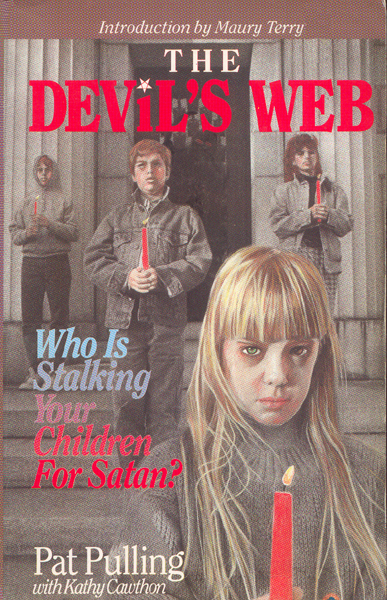
Irving's story, however, showed a collection of deeper problems: he idolized Adolf Hitler, had trouble fitting in with his schoolmates, and was often seen running through his backyard while howling at the moon. Pulling went on to form Bothered About Dungeons & Dragons (B.A.D.D.), a group that sought to ban D&D from schools and have a label placed on the covers of game books warning that the contents could cause suicide. She and her group were moderately successful in the former, but failed at the latter. During her involvement with B.A.D.D., Pulling would often distribute newspaper articles that had been edited to help prove her point - she would change the order of paragraphs to put an anti-game slant on the story, and remove anything that did not support her beliefs. This is not only dishonest and misleading, it is illegal. (Examples of the "Pat Pulling Editing Method" can be found here and here). Ever since these two events occurred, many have associated gaming as a possible cause in any crime committed by, or even against, a gamer, or someone who is assumed to be a gamer. In this manner, gaming has been associated with every crime imaginable, from robbery, burglary, and drug abuse to rape, suicide, and murder. This certainly has been assisted by people such as Mrs. Pulling who have done all that they can to propagate such untruths. Yet in every case, a saner, more realistic, and more probable cause can easily be found. That is, when games are even involved at all; 20% of all "game related" cases do not involve any form of game, but are assumed to by investigators and reporters. The Columbine massacre is possibly the most famous example of this. Since CCGs began their existence with Magic: The Gathering (which is based on a fantasy spell-casting environment) and were born out of the popularity of RPGs, they have received a "guilt by association" charge by many of the anti-gamers.
The truth is, as proven by the Center for Disease Control, the Albert Einstein College of Medicine, the American Association of Suicidology, and Health & Welfare Canada, is that role-playing games do not cause their players to kill themselves. With this knowledge in hand, all of the remaining accusations against games and gamers become dubious. In fact, when one compares the 80-plus cases of crimes where gamers were involved versus the millions of people who enjoy games on a regular basis, an abysmally small percentage, way below the norm for people of any specialty group, is the result. Could it be that playing D&D or Magic actually prevents crime? What anti-gamers like Pat Pulling didn't realize was that the numbers they once tossed around, if they had any basis in reality, would actually prove the opposite of their claims - that role-players had an abysmally small suicide and crime rate among their members, small enough to consider the hobby as a possible deterrent to violent and criminal behavior, rather than a cause of it. For more information on that subject, click here.
The movie managed to reinforce some of the negative stereotypes about gamers - that we are weird, eccentric social outcasts obsessed with a child's game - but that doesn't appear to be it's true intention. Jaffee was allegedly more interested in writing a novel based on a topical news story of the time, and wasn't using the book as a centerpiece for an anti-game campaign. The movie still pops up from time to time on late night television, and has recently been released to DVD. For more about Mazes and Monsters, click here to see its entry in the Gaming Advocacy Encyclopedia, or visit the internet's (allegedly) only Mazes and Monsters fansite.
No one ever seems to be overly concerned when their children play cops & robbers or cowboys & indians - games that many of today's parents grew up on. RPGs are very much the same thing. Role-playing games, like any other game of make-believe, are very much a blank canvas. The players and game master decide what gets painted on that canvas, and what course the story takes. If they choose to play a game filled with blood and gore, there is nothing short of parental intervention to stop them from doing so. As with any activity, a parent needs to supervise what their child is doing, and ensure at all times that they approve of what is going on. Magical spells only exist in games that support such a thing in their game world; in other words, Dungeons & Dragons has spells that can be cast by the characters, but the Men In Black RPG does not, because characters in that setting do not normally have magical powers. Spells in a game are not something that can be used in real life, by any stretch of the imagination. Instead, they are tools that the characters (not the players) use to perform some sort of action. One spell may open locks, allowing a character to free a trapped ally, while another may allow the character to fly or heal the wounds of others. While there are a few games on the market that attempt to simulate the effects of "real world" occultism and witchcraft (such as Nephilim or Authentic Thaumaturgy), none of these games could ever be considered a lesson in how to use real spells. Just as a player cannot learn horseback riding or blacksmithing from playing these games, they also cannot learn how to throw fireballs around. For a helpful resource on roleplaying games for children, including an extensive list of available games with parental advisories for each, be sure to visit The Young Person's Adventure League.
In one case, the owner of a Texas gaming store was told his establishment attracted undesirable types of customers, and he was not allowed to renew his lease. A child custody case in Delaware attempted to prove a father was unfit because, among other reasons, he allowed his son to play a computer D&D game. In one of the more extreme situations, a young man was beaten by his father after he returned from a police seminar on the dangers of role-playing games - apparently in the hopes of driving some of the demons out of his son. These are the types of things that result from misinformation, lies, and paranoia. The bottom line is that the accusations made against games are false. That in itself is enough to warrant all of this effort.
First - parents, teachers, and members of the clergy can (and will) be mistaken about things from time to time. We all can. It's part of being human. If you are under eighteen (or thereabouts) and/or still living with your parents, you must respect their rules and wishes. If they say no gaming, then you have no choice. Your respect for your parents must come above any leisure activity. (This is not to say that you shouldn't try to educate your parents about the hobby, as long as you do it in a respectful manner). It's just a game, after all, and it's certainly not something worth driving a wedge between you and your parents over. The same goes for your teachers. Many schools have banned RPGs and other games on the basis that they are "bad" for the people who play them. If this is the case where you go to school, please respect their rules... but don't be discouraged from trying to show them the truth. Your best course of action when attempting to show anyone the real truth about role-playing games is to stay calm and open-minded to their concerns. An argument will never accomplish anything worthwhile. Instead, offer to set up a demonstration of an RPG or LARP for people who have never seen one before. Let them look through the rulebooks and ask you about anything that causes them concern. Explain terms and jargon as you go along, and let them interrupt you with questions. If they seem open to it, send them the link to this FAQ so that they can find out more. During all of this, make sure that they understand that you know they always have the authority to say "No" if they still haven't changed their mind. Even if that is their final word, you will have done your absolute best, and possibly even earned a little more respect in their eyes for giving them so much respect yourself. Gaming and God I'm not here to give spiritual advice to anyone, but I would like to bring up an important point. There is a usenet posting that has been on the web for some time that was written by David Fisher, an ex-gamer who gave up the hobby because he felt it was damaging his relationship with God. In the introduction, he goes to great lengths to explain that he is not condemning gamers, only explaining why he chooses not to play anymore. He then goes on to condemn gamers anyway, by comparing our hobby to some very horrible things. (If you like, you can read it in the Escapist Archives.) But in this article he does make an important point: each of us should weigh everything we do with how it affects our spiritual life. Not just gaming, but everything. If you can honestly say that something you do as a hobby has changed you for the worst, made you unhappy, or damaged your relationship with God (or Budda, or Allah, etc.) then you need to give it up. This is your own decision based on your own feelings and experiences, and should never be decided for you by someone else - especially someone babbling about it on the internet (and that includes myself). Meanwhile,
please keep in mind that your choices are your own. You may
encounter others who feel that their hobby is fully compatible with
their spiritual life. In fact, this can be said about almost
every gamer. They have made their choice. Please
respect it.
It is true that the public opinion of the role-playing hobby has shifted in the last couple decades, from wild claims of Satanism, occultism, murder, suicide, and crime, to a general opinion that it's something that painfully geeky people do for fun. These days, most references to Dungeons & Dragons or role-playing games on television or in the movies are much more kind than they used to be, and we have even seen shows and movies based on gamers and specific games. Every so often, however, another incident will pop up that will somehow get attached to RPGs. In 2002, the brother of Stephanie Crowe and his friend were found innocent of her 1998 murder when new evidence linked the crime to someone else - until that day, the only evidence against the boys was a coerced confession by police that revealed that both were D&D players. As one news story put it:
That same year, the DC Beltway Snipers were incorrectly profiled as possible D&D players, based solely on the fact that they left a Tarot card behind (even though Tarot and D&D have practically nothing to do with each other). In 2005, a town in Brazil passed a law banning the sale of RPG books after rumors began to fly about a possible connection between an RPG and a triple murder case. There are still misconceptions, misinformation, and downright lies about role-playing and role-players. It's just not as common as it used to be. But that isn't the only subject that gaming advocacy covers. There's also bringing new people into the hobby, encouraging parents to play with their kids, encouraging gamers to support their local game shops and conventions, using roleplaying as a teaching tool in the classroom, and inspiring gamers to donate their time and resources to philanthropic endeavors. This site covers all of these a little now, and in the future it will broaden each of them until the occasional misinformed news items will hardly be noticable anymore.
This is one of the most requested nuggets of information here at The Escapist. I've nicknamed it the Suicide Statistic Fallacy, and it comes from Michael Stackpole's 1989 document Game Hysteria and the Truth. The statement that Stackpole makes does not go so far as to suggest that gamers are any less likely to kill themselves than non-gamers - rather, it demonstrates the useless and arbitrary statistics that are favored by anti-gamers, and uses them to disprove their own cause:
It's also interesting to note that Stackpole mentions how the suicide rate began to fall after 1980 and continued to fall through the rest of the 80s, which was the same time that the popularity of Dungeons & Dragons began to soar. It bears repeating: This
should not, in any way, be taken as a scientific study that gamers are
less likely to kill themselves or others. Such
studies may exist, but this is not one of them. Some of the
numbers used here are from Pulling herself, and are far from
accurate. Her claim of 125 gaming-related crimes is
questionable, considering that she never supplied anyone with a
complete list, but instead relied on claims of unpublicized and
confidential cases that no one can verify. The primary point
here is that if she really wanted to use arbitrary numbers to prove
that games cause people to kill, she should have set those numbers much
higher in order to break the national averages.
The roleplaying hobby has a lot of social, developmental, and educational benefits. It encourages literacy, teamwork, and problem solving, it develops math and spatial thinking skills, and it helps build friendships. You can read more about these benefits on the What Roleplaying Games Are FAQ page.
The trend seems to have begun as a direct response to public concern over a relatively "new" fad. But many preachers and other religious authors grew concerned over the presence of magic, demons, devils, and polytheistic gods in the game, and added these in with their lists of grievances against it. Suddenly, D&D was an indoctrination tool for Satanists and witch's covens, as well as a suicide and homicide threat - despite the absolute lack of any evidence to this end. One popular spiritual tirade against D&D, for example, addresses the amount of times the words demon and devil appear in the Monster Manual, and compares this to the same totals found in the Bible. As anyone can imagine, this book of fantasy creatures (listed as opponents for player characters) had a considerably higher count of these words than the Bible did. It boggles the mind to think of someone seriously comparing the literal content of a fantasy game to the literal content of the Bible, and using this as a gauge of how "evil" the book is. Does this mean that books that do not mention demons or devils at all are actually more holy than the Bible? Two preachers who began to publish pamphlets in this tradition were the Rev. James R. Cotter and John S. Torrell. Due to a long tradition among preachers of prolific cutting and pasting, much of the rhetoric seen in religious anti-gaming materials can be traced backwards to the work of these two men. As you can see, it doesn't take a whole lot to start an urban legend or a nasty rumor - just a few choice words in just the right places.
The less intelligent non-humans will serve for from 10% to 60% less cost, but these evil creatures will certainly expect to loot, pillage, and rape freely at every chance, and kill (and possibly eat) captives. - First edition Dungeon Master's Guide, page 31, second column, first paragraphObviously, this is something that has been taken out of context. For starters, this statement comes from a section on non-humans (orcs, goblins, and such) as hired troops - it does not apply to the motives or desires of player characters. Secondly, the point being made here is not that you should include graphic scenes of rape or murder in your games - but that relying on evil creatures to do your work for you can have some terrible outcomes. Note how this sentence mentions that "evil creatures... loot, pillage, and rape." If anything, this statement makes it clear that crimes such as looting, theft, and rape are evil activities. And that's a good thing to make clear to D&D players, isn't it? The second statement is found later in the book, in a description of a city encounter. Dungeons & Dragons uses random encounter tables to simulate chance meetings with other characters or monsters. One of these tables is for encounters in a city or town, and lists the people that you can meet there - shopkeepers, city guards, citizens, and so on. One of the entries on that table is "goodwife," and the description reads as follows:
It would be somewhat of a desperate reach to suggest that this statement was promoting rape, but that's exactly what Patricia Pulling did in her book, The Devil's Web. In her typical form, she had to edit the statement down a bit to make it sound more convincing:
To better illustrate her editing technique, here is the complete paragraph, with the words she chose to delete in red:
Note how the words have been edited (from 60 to 15 words, without proper notation) to "put a spin" on this statement and make it into something sinister. It's not even a good attempt; the result is something that barely makes any sense. This is, unfortunately, a very common practice among people who are desperate for evidence to support their cause. Rape is a very serious issue, and certainly nothing that should be made light of in something like a role-playing game. These quotes taken directly from the Dungeon Master's Guide show that it is considered a serious issue in its pages as well - it is depicted as both an evil act, and something that can bring serious repurcussions. For the record, these statements only appear in the first edition of the Dungeon Master's Guide; all subsequent editions (since 1990) do not include any information regarding this issue. (For more examples of Pulling's editing methods, read this section of Michael Stackpole's Pulling Report.)
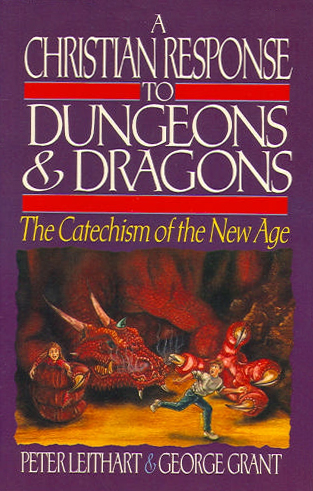
No, they do not. This is another rumor that started from a misquoted passage in the original Dungeon Master's Guide. This claim was made in a 1987 pamphlet called A Christian Response To Dungeons & Dragons by Peter Leithart and George Grant, and it has appeared in many other places as well:
Here is the statement that they have drawn this claim from:
The truth here, as anyone can see, is that Hitler was being used as an example of someone who had much in the way of personal magnetism, but little in the way of physical attractiveness. Attempting to make any other interpretation is taking the material out of context. Sometimes people feel it's acceptable to lie or reorder a few words deceptively, just so long as they get the point across. Among many other false claims that Leithart and Grant make in the Christian Response pamphlet is this one:
And it would be blasphemy... if it were true. Jesus Christ does not appear in any edition of any Dungeons & Dragons book, as a diety, character, monster, or otherwise. (Some would probably consider that a sign of corruption itself, creating a very handy no-win situation for the game.) The statement above is an outright falsehood. Note carefully the logic here: If we really want to get people fired up against this game, let's make up a story about how blasphemous it is and how it venerates Hitler. It won't count as a sin if we do it in the name of God! It should be noted that the above example from the Dungeon Master's Guide only appears in the first edition; all subsequent editions (since 1990) do not include it at all. The 1987 pamphlet, however, has been digitized and is still distributed freely to Christian homeschoolers and educators to this day. (You can read the pamphlet, in web or PDF format, here.)
Here is a direct quote from his article Straight Talk On Dungeons and Dragons (the emphasis in bold is his own):
These two guys sat in our living room and took copious notes from us on how to make sure the rituals were truly right "from the book," (this meaning that they actually came from magic grimoires or workbooks). They seemed satisfied with what they got and left us thankfully.
Schnoebelen's story sounds convincing, but overlooks the fact that by the late seventies, D&D was already published and on the shelves for several years - which would have made it a little late to do any kind of research for it. The Advanced version of the game saw publication in 1979, but very little changed in the way that spells were listed - the rules surrounding each spell were expanded a little and variables were adjusted to accomodate the new rule system, but none of this could be considered "reality-checking" the game against real world occultism. There is also another inconsistency in this story. If the alleged "rituals" in these rulebooks are "authentic... (f)or the most part," then why did these two men need to take "copious notes" from Schnoebelen and his wife? D&D spells, as has been asserted before, are not "rituals," or even anything used by the players. Fireballs and magic missiles, very common magical effects in D&D, are not the sorts of things that "real" high priests or Satanists can cast, or would claim to be able to cast. Schnoebelen may disagree with this premise, but until he can actually summon a ball of fire from his fingertips, his claim doesn't hold much weight. No names or descriptions of these two field-testing game designers are given, so we can't even be sure if these were actual representatives of TSR, two guys pulling a practical joke on the Witch High Priest of Milwaukee, or a simple figment of Schnobelen's imagination. In my quest for an answer to this claim, I went straight to the horse's mouth - Gary Gygax, co-creator of the original Dungeons & Dragons - and asked him if there was any truth to this story. His simple answer: "Pure rubbish, that assertion!" Still, this would not be enough for some people, as it's purely one word against another - and in Schnoebelen's mentality, all occultists are known to lie (except the reformed ones, of course). So the only thing we have to go on would be his veracity. What other claims has he made, and how truthful are they?
For that, I refer you to his take on Cthulhu (from Should A Christian Play Dungeons & Dragons?):
Yes, you heard it here first, friends - there really is a massive, octopoid aberration living in a non-Euclidean city beneath the ocean, awaiting an alignment of the stars to awaken and destroy us all. Schnoebelen also claims to be a former vampire, and tells this story in the film Interview With An Ex-Vampire. During his time as a Satanist/vampire, he built a special trapezoidal "vampire coffin" designed to attract "vampiric dark demonic energy" to help the occupant achieve "demonic resurrection" - the same sort of coffin in which Pope John Paul II was laid to rest! In the independent gaming documentary Über Goober, Schnobelen tells the story of how opposing warlocks would materialize in his home, attacking him and his wife via astral projection - and how a good friend of his was so adept at it that he could project himself into movie theaters to skip the admission fee. So
who do we believe? A guy who makes a game about imaginary
monsters, or a "vampire coffin designer" who actually believes
in imaginary monsters, and believes that he was one,
once upon a time? I'll let you decide that for yourself.
Not at all. In fact, you'll notice that I'm usually very careful about making it clear to everyone that I do not paint all members of any group with the same brush. During the initial media coverage of Columbine, I was accused of calling a police officer an "idiot" because he allegedly made some disparaging statements against Vampire: The Masquerade. This bothered me a lot because I've never called anyone an idiot on this site, and I would never judge someone like that based on a single statement that they made. I offered to give equal time to the officer, whom my accuser knew personally, but the offer was never accepted. Hopefully, the officer saw my side of the story - or is at least aware that I never called him an "idiot." If I criticize anything, it is actions, not the people who perform them. There is "good" reporting - seeking out the truth to report on it, "poor" reporting - when the required research to properly present a story is not done, and "bad" reporting - when a flashy headline is used to sell papers at any expense. No one would seriously suggest that all reporting falls into the latter two categories - and I am the first to make it known when a positive gaming story hits the paper or the TV screen. Unfortunately, that's not that often. The same can be said about investigators. William Dear, who hid the truth from the world in order to protect the reputation of his clients, ended up doing more harm than good to a lot of people who enjoy role-playing. This does not make him a "bad" investigator - far from it. He has a reputation as one of the best investigators of our time, with the track record to back it up. He simply made, in my opinion, a bad decision. For me to criticize Christianity because of the flak that gaming has taken from several Christian leaders would be more than illogical - it would be hypocritical. To me, gaming is a form of freedom of speech, and in the United States, that right is guaranteed to us by the same amendment that gives us freedom of religion. If I had a grudge against Christians, I'd also have to include all of my gaming friends who are Christians - that's most of them, by the way. I'd have to turn my nose up at all the emails I get from Christian gamers who write to encourage me and apologize on behalf of the "bad apples." I don't plan on doing any of this, ever.
I am very careful not to attack anyone's religion or spirituality on the site, and I'd like to think that I've done an excellent job of it. I am critical of certain beliefs, it's true - but they are limited to the following: - The belief that role-playing games can cause you to kill yourself, others, or engage in any other dangerous or criminal activity that you would not have if you had never started playing. - The belief that role-playing games are spiritually dangerous, and can attract demons to possess the players, or bestow the players with the ability to cast spells, summon demons, or any other supernatural powers. - The belief that a god or gods are not happy with people playing roleplaying games (yet somehow have no problem with people playing roles on stage or in TV or movies). These beliefs do not exist as canon or scripture in any holy book of which I am aware, so it can be safely said that I do not criticize any actual religious beliefs here on the site - only the crazy ones that people have added on their own.
This is, without a doubt, my most frequently asked question. I feel that this matter is a very personal one, so I respectfully decline to answer. Here’s why: This site, and the entire cause of gaming advocacy, deals in facts; the “reality of fantasy games,” as I like to put it. My personal belief system does not change these facts.
Many people do not agree with this, however. They see a person's religion (and sometimes even their denomination) as a primary factor in their veracity. It's a very shallow way to think, but unfortunately, it's the way that things are. These people would truly doubt the accuracy of something written on these pages, based on how closely my belief system matches theirs. One email I received from an Escapist reader who is a Jehovah’s Witness mentioned that a fellow church member was surprised to hear a rumor that Gary Gygax was a Witness, and even made the comment that “he probably isn't anymore.” This is an example of the way that some people think – this person was of the opinion that Mr. Gygax had left or even been “kicked out” of the Witnesses for being involved in the creation of Dungeons & Dragons. Such small-minded discussions are petty, trivial, and superficial, and it is my intention to avoid supplying fuel for such things. The truth is the truth, plain and simple.
It may seem that I am 'protesting too much' (to quote Shakespeare) by pointing these things out in such detail - in other words, I may be going through a lot of effort to cover up something. This is a tactic often used by those who aren't happy with the fact that someone is looking at their extraordinary claims with a critical eye. In some cases, it may even be made by gamers themselves, who feel that all of this brings undue negative attention to the hobby. I respectfully disagree. The myths and misconceptions about the RPG and LARP hobbies are part of their history. They will not go away if we ignore them, and when they do come up in conversation, or in a news item or website, it's best to have some sort of resource that points to the truth. It's just my humble opinion, but I feel that bringing these claims into the light and showing how they fall apart is much better than stuffing them under the bed and hoping that no one will ever see them.Sometimes, the response to a claim can get a little verbose, and seem like it is "protesting too much." It's very easy to make up a falsehood about any particular subject, or pass on that falsehood to others, but it takes a lot of work and words to correct those falsehoods. As in the example above, it is extremely easy for Patricia Pulling to pare down a paragraph from a D&D book to a quarter of its former self in order for her to make a misinformed point - but it takes a lot more effort and explanation to show what was done and why it was wrong. If none of this helps, then allow me to put it another way: Think about a hobby or pasttime that you and others enjoy - something that relaxes you, keeps your mind and hands active, and maybe even keeps you out of trouble. It could be model building, quilting, fly tying, wind surfing, or collecting political campaign buttons. Now, imagine how you would feel if someone started speaking out against that hobby, wrongfully calling it dangerous and trying to get it banned from schools and public places, for reasons that have no basis in reality. Wouldn't you want to set the record straight, if no one else was? Or consider this one: You're a parent of a teen or pre-teen who is going through the usual growing pains. You spot some roleplaying books in their room - books with pictures of demons and monsters and vampires in them. You've heard some awful things about these kinds of games, but you really want to find out more for yourself before you make up your mind about it. Where are you going to go to find the truth about these games?
If the question here is whether or not I make a profit through the RPG industry, then the answer is no. That has changed from time to time - I once had a small business that sold used copies of RPG books, I used to write for a gaming magazine, and for a brief while I was even working for a company that planned to publish role-playing games. Armed with the knowledge of this, some people will think that all of this work is just a money-making ploy, a plan to make something "bad" seem "good" in order to cash in on it. Well, nothing could be further from the truth. I do this because I love the hobby, I'd like to see it flourish, and I hate the lies and misconceptions about it. It's not that different from a fishing enthusiast who creates a page of information about the benefits of taking your kids out to catch some trout, or a coach who speaks out against negative press that high school sports have been getting. I like role-playing, I enjoy teaching people about it, and I'd love to see more people get involved in it. Nothing more, nothing less.
This ends the Basic Gaming FAQ. You can learn more about role-playing games by exploring the other FAQ files in this section:
|